DGA Authorization

IO Consulting Officially Authorized to Conduct Information Security Audits in Georgia

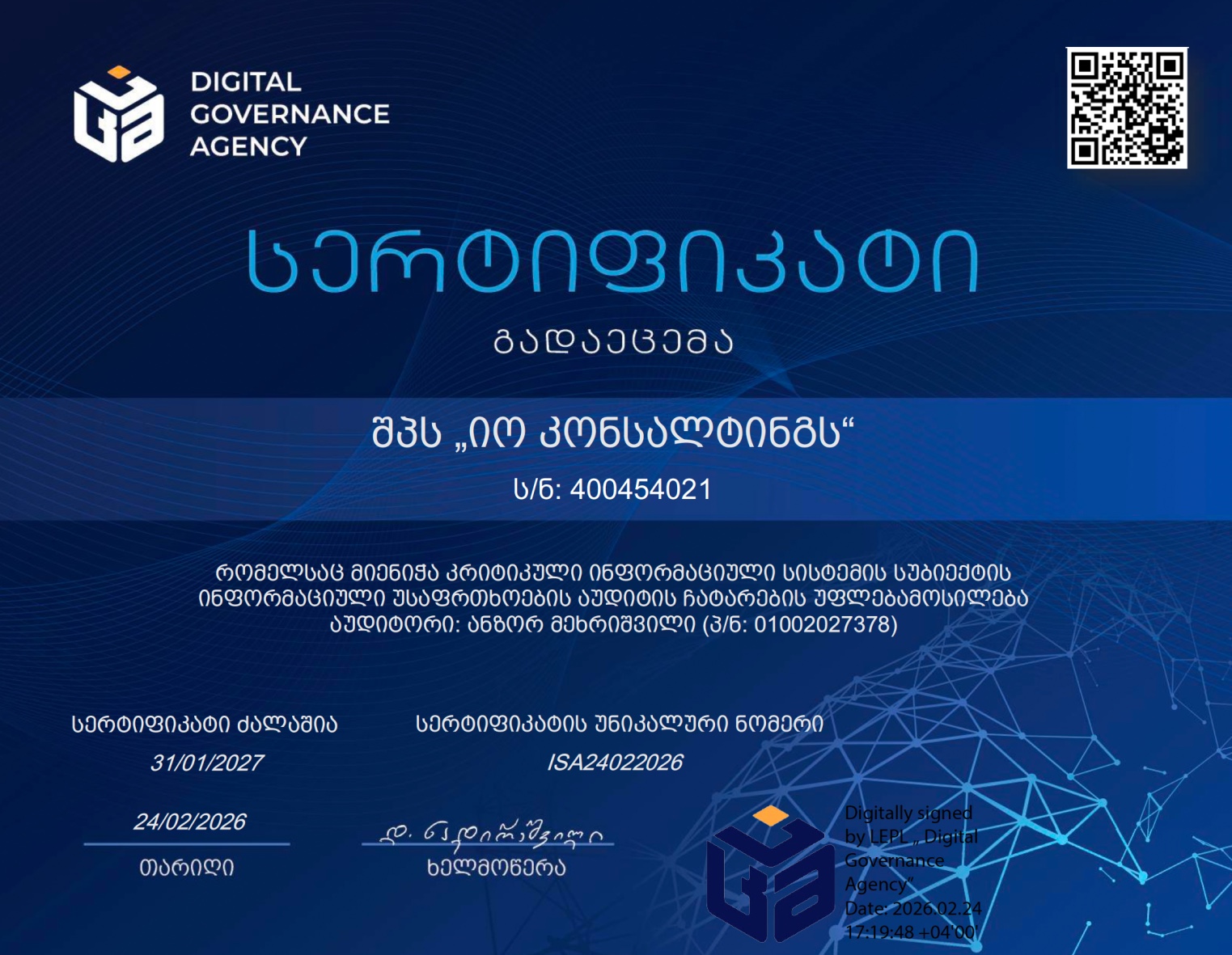
IO Consulting has been officially included in the list of organizations authorized to perform information security audits under the framework administered by Georgia’s Digital Governance Agency.

The official register of authorized organizations, auditors, and penetration-testing professionals identifies IO Consulting LLC as an organization authorized to conduct information security audits. The authorization was granted on 24 February 2026 and is linked to the professional qualification of Anzor Mekhrishvili, a Certified Information Systems Auditor – CISA, certified by the Information Systems Audit and Control Association, commonly known as ISACA.

This recognition represents an important milestone in IO Consulting’s development as a Georgian cybersecurity, information security, digital governance, and technology assurance consultancy. It also provides clients with formal confirmation that the company has met the professional and regulatory requirements established for organizations performing information security audits within the applicable Georgian legal framework.

What Does the Authorization Mean?

Information security auditing is not merely a general consulting activity. In regulated circumstances, an audit may need to be performed by an organization and an auditor formally recognized by the relevant state authority.

The official list published by the Digital Governance Agency distinguishes between two types of authorization:

  • Information security auditing;
  • Penetration testing.

IO Consulting is listed under the information security audit authorization category. This means the company is entitled to provide authorized information security audit services through the auditor specified in the Agency’s decision and during the applicable authorization and certification period.

The official document also clarifies that an information security audit or penetration test may be performed on behalf of an authorized organization only by the auditors or testing professionals specifically named in the Agency’s decision. Their authority remains valid during the validity period of the relevant professional certificate or, where a certificate is issued without an expiry date, for the period established under the Agency’s authorization rules.

Accordingly, authorization is not granted solely on the basis of a company’s commercial activities or self-declared expertise. It is connected to identifiable professionals, recognized qualifications, and a formal regulatory decision.

Why This Recognition Is Important

The inclusion of IO Consulting in the official register is important because information security audits can influence decisions involving regulatory compliance, cybersecurity investment, risk treatment, critical infrastructure protection, and organizational accountability.

An audit report may be reviewed by executive management, supervisory bodies, regulators, business partners, investors, customers, internal audit functions, and boards of directors. For this reason, the organization performing the audit must demonstrate not only technical knowledge but also professional competence, independence, consistency, and accountability.

Authorization provides clients with an additional level of confidence that the audit is being conducted by a company recognized within the official Georgian framework and through an appropriately qualified auditor.

It also helps organizations avoid the risk of commissioning a regulated audit from a provider whose report may not satisfy formal eligibility requirements.

More Than a Compliance Exercise

An information security audit should not be treated as a document-checking exercise or as a process designed only to demonstrate formal compliance.

A properly planned audit evaluates whether security controls are:

  • Appropriately designed;
  • Formally approved;
  • Effectively implemented;
  • Consistently applied;
  • Supported by sufficient evidence;
  • Monitored and reviewed;
  • Aligned with actual business and technology risks.

For example, an organization may have an approved access control policy, but the audit must determine whether user access is actually reviewed, privileged accounts are controlled, terminated employees are removed from systems promptly, authentication requirements are enforced, and exceptions are documented.

Similarly, the existence of an incident response plan does not automatically mean that the organization is prepared to manage a cyber incident. Auditors may need to assess whether responsibilities are assigned, escalation rules are defined, incidents are classified, evidence is preserved, communications are coordinated, exercises are conducted, and lessons learned are incorporated into the security programme.

This distinction between documented intention and operational effectiveness is one of the central benefits of an independent information security audit.

A Risk-Based Approach to Information Security Auditing

IO Consulting’s audit approach is based on the principle that audit activities should reflect the organization’s actual risk profile.

Not every control carries the same significance. The potential impact of a weakness depends on the organization’s services, information assets, technologies, threat exposure, legal obligations, dependencies, and business criticality.

A risk-based audit therefore considers factors such as:

  • The sensitivity and importance of information;
  • The criticality of systems and services;
  • The likelihood and impact of cyber threats;
  • Dependence on third-party and cloud services;
  • Privileged access exposure;
  • Legacy technology;
  • Business continuity requirements;
  • Previous incidents and audit findings;
  • Regulatory expectations;
  • The maturity of the organization’s governance structure.

This approach enables the audit to focus attention on the areas that could create the most significant legal, operational, financial, or reputational consequences.

Areas That May Be Covered by an Information Security Audit

The exact scope of an audit depends on the applicable requirements and the organization’s environment. Depending on the engagement, IO Consulting’s audit activities may include an assessment of:

This includes the organization’s governance model, management oversight, policies, security roles, accountability, reporting mechanisms, and decision-making processes.

The audit may assess whether information security risks are identified, analysed, evaluated, treated, accepted, monitored, and reported using a consistent methodology.

This area may include the identification and classification of information, systems, infrastructure, software, services, and other assets, as well as the assignment of ownership and protection responsibilities.

The review may cover user lifecycle management, authentication, privileged access, segregation of duties, access reviews, shared accounts, remote access, and third-party access.

This may include secure configuration, vulnerability management, patching, malware protection, logging, monitoring, backups, network security, change management, and system administration.

The audit may assess incident identification, reporting, classification, escalation, response, communication, evidence preservation, recovery, and post-incident improvement.

Organizations often rely on cloud providers, software vendors, outsourced service providers, consultants, payment processors, and other third parties. The audit may therefore evaluate supplier due diligence, contractual safeguards, ongoing monitoring, and exit arrangements.

This area may include business impact analysis, continuity strategies, disaster recovery, backup restoration, crisis management, testing, and dependency management.

The audit may evaluate security responsibilities throughout the employment lifecycle, including screening where applicable, confidentiality commitments, awareness, disciplinary processes, role changes, and termination procedures.

Depending on scope, the audit may cover physical access, secure areas, equipment protection, environmental threats, visitor management, and the protection of supporting infrastructure.

The review may also address legal and contractual obligations, privacy-related controls, internal review mechanisms, previous findings, corrective actions, management reporting, and continuous improvement.

The Value of Independent Assessment

Internal teams are essential to the operation of an information security programme, but they may be too close to established processes to identify every weakness objectively.

An independent audit introduces a structured external perspective. It can reveal:

  • Controls that exist only in documentation;
  • Informal practices that depend on individual employees;
  • Responsibilities that are not clearly assigned;
  • Security tools that are deployed but not effectively monitored;
  • Policies that no longer reflect the technology environment;
  • Risks that have been accepted without formal approval;
  • Recurring findings that have not been fully resolved;
  • Gaps between management expectations and operational reality.

Independence also strengthens the credibility of the results. An audit performed by an authorized external organization can provide stronger assurance to management and relevant stakeholders than a purely internal self-assessment.

Delivering Actionable Audit Results

The value of an audit depends significantly on the quality of its findings and recommendations.

A useful audit report should explain:

  • What was assessed;
  • Which criteria were applied;
  • What evidence was reviewed;
  • What control weakness was identified;
  • Why the weakness matters;
  • What risk may result;
  • What corrective action is recommended;
  • How significant the issue is;
  • Who should be responsible for remediation;
  • How remediation should be verified.

IO Consulting focuses on presenting findings in a way that is technically accurate but also understandable to management and decision-makers.

A finding should not merely state that an organization is “non-compliant.” It should clearly describe the gap, the associated risk, and the practical steps required to address it.

This allows organizations to convert audit results into a realistic remediation roadmap rather than treating the final report as a static compliance document.

Why Organizations May Choose IO Consulting

IO Consulting combines formal authorization with experience in information security, cybersecurity governance, IT auditing, risk management, regulatory compliance, and international standards.

The company’s approach is designed to bridge the gap between technical security, governance, and business priorities.

This is important because information security problems rarely exist in isolation. A technical vulnerability may result from weaknesses in procurement, change management, asset ownership, staff competence, vendor oversight, budgeting, or management supervision.

An effective audit must therefore examine both the technical issue and the governance conditions that allowed it to arise or remain unresolved.

By combining audit discipline with practical cybersecurity and management-system expertise, IO Consulting can support organizations in understanding not only whether a gap exists, but also why it exists and how it can be corrected sustainably.

A Trusted Partner for Digital Assurance

The official authorization of IO Consulting to conduct information security audits is an important recognition of the company’s professional capability and commitment to high-quality assurance services.

For clients, it means access to an audit provider that is formally included in the Digital Governance Agency’s list of authorized organizations and supported by an internationally recognized CISA-qualified auditor. The official register records IO Consulting under identification number 400454021, with information security audit authorization dated 24 February 2026.

For IO Consulting, this recognition reinforces the company’s mission to help organizations establish secure, resilient, accountable, and trustworthy digital environments.

As cyber threats, regulatory expectations, and technology dependencies continue to increase, organizations require more than isolated technical solutions. They need independent assurance that their governance structures, processes, technologies, and security controls operate effectively as an integrated system.

IO Consulting is positioned to provide that assurance through authorized, evidence-based, risk-focused, and professionally conducted information security audits.

Building Digital Trust Through Independent Assurance

Trust in the digital environment cannot be created through declarations alone. It must be supported by effective controls, competent professionals, transparent governance, reliable evidence, and independent assessment.

The authorization granted to IO Consulting confirms the company’s role within Georgia’s information security assurance ecosystem and strengthens its ability to support both public- and private-sector organizations.

Through its information security audit services, IO Consulting helps organizations identify weaknesses before they develop into serious incidents, understand their compliance position, improve operational resilience, and demonstrate accountability to regulators, customers, partners, and management.

This achievement represents not only a formal authorization but also a responsibility: to conduct every engagement with independence, confidentiality, professional care, objectivity, and a consistent commitment to protecting the digital interests of clients.