
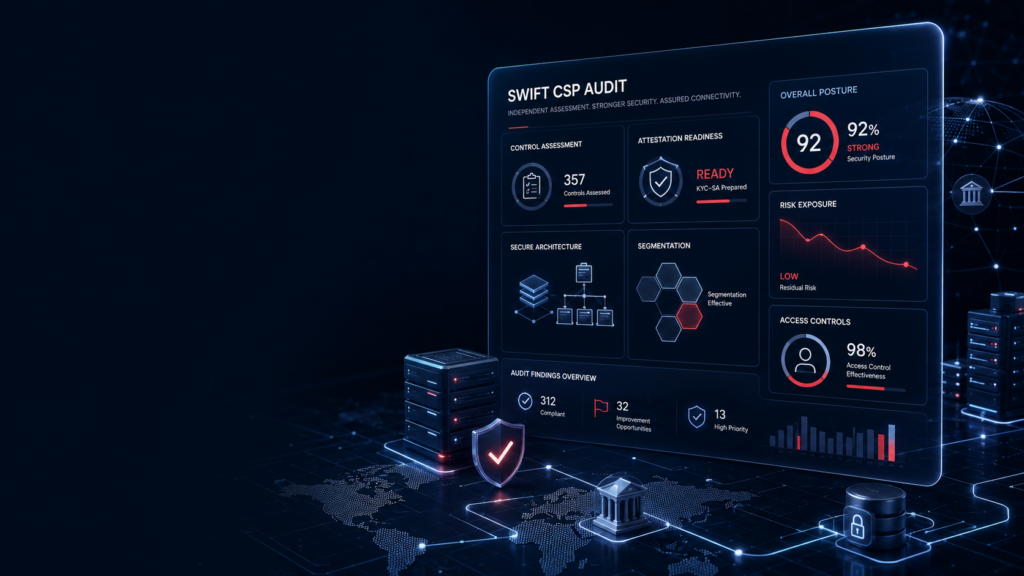
SWIFT CSP Audit
Independent assessment against the SWIFT Customer Security Programme (CSP) framework – protecting your payment infrastructure and your SWIFT connectivity.
What Makes SWIFT Audits Different
Annual Attestation Cycle – SWIFT CSP compliance isn’t a one-time exercise – attestation is required annually, with control requirements periodically updated by SWIFT. We help you build a repeatable assessment process, not just pass one cycle.
Mandatory vs. Advisory Controls – The CSCF distinguishes mandatory controls (required for attestation) from advisory controls (recommended best practice). We assess both, and help you understand where advisory controls meaningfully reduce your actual risk exposure.
Correspondent Bank Scrutiny – Your KYC-SA attestation may be reviewed by correspondent banks as part of their own risk assessment of you. A rigorous, well-documented independent assessment strengthens your standing in these relationships, not just your SWIFT compliance status.
What You Get
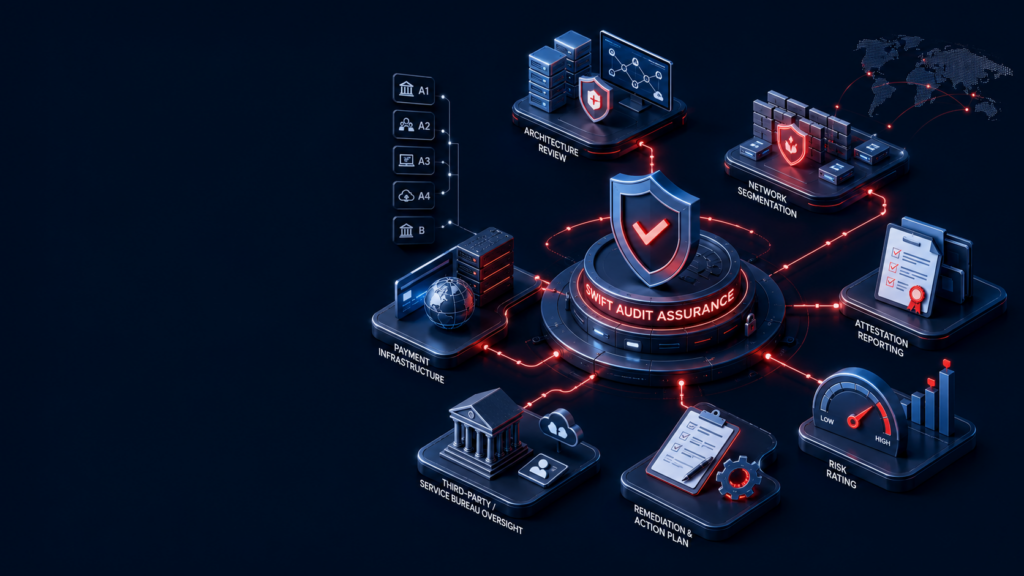
Full CSCF Control Assessment
Independent testing of mandatory and advisory controls under the current SWIFT Customer Security Controls Framework (CSCF) version.
Architecture & Segmentation Review
Assessment of your SWIFT-related infrastructure, network segmentation, and secure zone design against SWIFT’s architecture requirements.
Attestation-Ready Reporting
Documentation structured to support your KYC-SA (Know Your Customer Security Attestation) submission, with clear evidence for each control.
Methodology
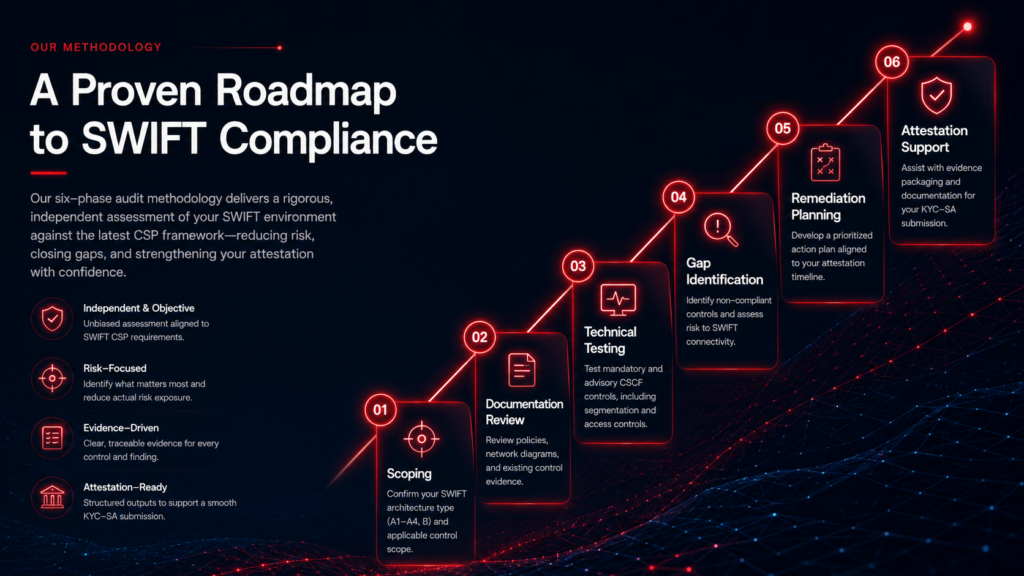
- Scoping – Confirm your SWIFT architecture type (A1–A4, B) and applicable control scope.
- Documentation Review – Review policies, network diagrams, and existing control evidence.
- Technical Testing – Test mandatory and advisory CSCF controls, including segmentation and access controls.
- Gap Identification – Identify non-compliant controls and assess risk to SWIFT connectivity.
- Remediation Planning – Develop a prioritized action plan aligned to your attestation timeline.
- Attestation Support – Assist with evidence packaging for your KYC-SA submission.
Architecture Types We Audit
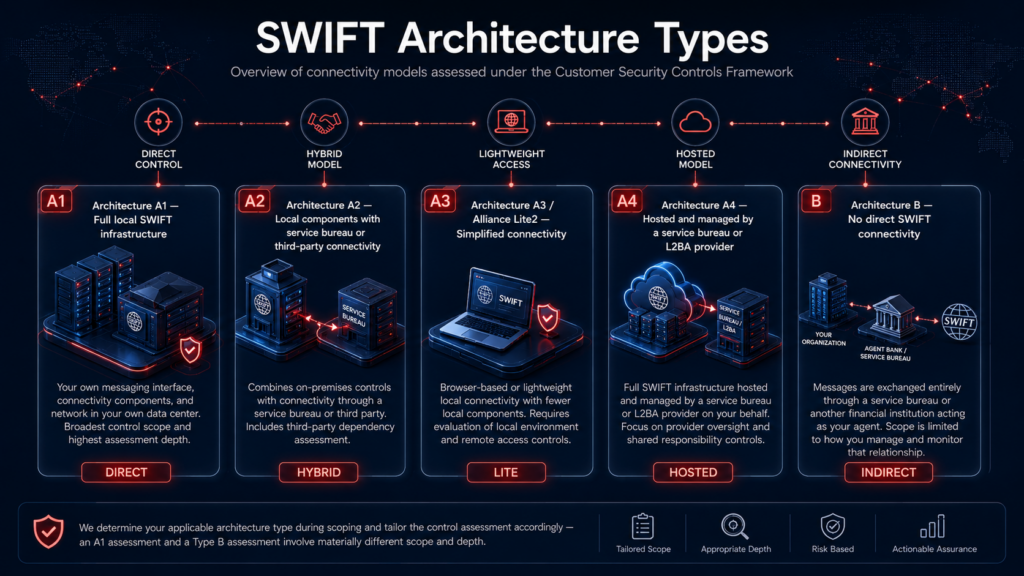
SWIFT’s Customer Security Controls Framework (CSCF) defines control requirements based on how your organization connects to the SWIFT network. We assess compliance across all architecture types:
- Architecture A1 – Full local SWIFT infrastructure — your own messaging interface, connectivity components, and network in your own data center. The broadest control scope, requiring the most comprehensive assessment.
- Architecture A2 – Local SWIFT-related components with connectivity through a service bureau or third party. Combines on-premises controls with third-party dependency assessment.
- Architecture A3 / Alliance Lite2 – Simplified, browser-based or lightweight local connectivity. Fewer local components, but still requires assessment of the local environment and remote access controls.
- Architecture A4 – Full SWIFT infrastructure hosted and managed by a service bureau or L2BA (Lite2 Business Application) provider on your behalf. Assessment focuses on your oversight of the provider and shared responsibility controls.
- Architecture B – No direct SWIFT connectivity — messages are exchanged entirely through a service bureau or another financial institution acting as your agent. Scope is limited to how you manage and monitor that relationship.
We determine your applicable architecture type during scoping and tailor the control assessment accordingly – an A1 assessment and a Type B assessment involve materially different scope and depth.
Who This Is For
Organizations that need to:
- Complete independent assessment for SWIFT CSP attestation requirements
- Validate self-assessment results before submission
- Strengthen segmentation and access controls around SWIFT infrastructure
- Prepare for a SWIFT-mandated independent assessment cycle
- Reduce risk exposure on payment messaging infrastructure
Why IO Consulting
Our team brings together certified audit expertise – CISA, CISM, ISO/IEC 27001 Senior Lead Auditor and Lead Implementer – with practical, hands-on experience in IT governance, network administration, systems administration, database administration and software development. This breadth of technical background allows us to understand client environments from the inside out, delivering audits that are both rigorous and precisely tailored to what each organization actually needs.